Tooth loss in the anterior maxilla is often associated with significant aesthetic, functional, and psychological concerns. During the healing phase after implant placement, it becomes essential to provide a temporary prosthetic solution that maintains appearance and protects the surgical site. Among the various interim options, Essix retainers with integrated pontics offer a conservative, minimally invasive, and esthetically acceptable alternative. This case report describes the prosthetic management of a 39-year-old male patient who presented with a missing maxillary left central incisor due to trauma. After clinical and radiographic assessment confirmed suitability for implant placement, a 3.5 mm × 11.5 mm titanium implant was placed under local anesthesia. To maintain the space and esthetics during osseointegration, an Essix retainer with a prefabricated acrylic pontic was fabricated and delivered. The patient was educated about maintenance, hygiene, and follow-up protocols. During periodic reviews, the healing was uneventful, and the patient expressed satisfaction with comfort and appearance. This report highlights the role of Essix retainers as a simple, cost-effective, and patient-friendly option for interim prosthesis in anterior implant therapy, especially when soft tissue preservation and esthetics are priorities during the transitional phase.
Key words: anterior implant, esthetic rehabilitation, essix Retainer, interim prosthesis, pontic, transitional appliance
Tooth loss in the anterior maxilla poses significant
aesthetic and psychosocial challenges. During
the osseointegration period following implant
placement, provisional prostheses play a pivotal
role in preserving appearance, phonetics, and
patient confidence. An ideal interim solution
should be minimally invasive, visually discreet,
and avoid pressure on the surgical site. The Essix retainer with an integrated pontic is one
such approach, offering high patient acceptance
and fabrication ease.1 This case report outlines
its use in managing left central incisor during
implant healing, highlighting its benefits over
traditional interim options.
A 39-year-old male patient presented to the
Department of Prosthodontics and Crown &
Bridge with a missing maxillary left central
incisor due to previous trauma. The patient
expressed a strong desire for an aesthetic and
fixed long-term replacement, opting for an
implant-supported prosthesis.
Extraoral examination revealed no significant
abnormalities (Figure 1). Intraorally, the patient
presented with a healed edentulous ridge in
the region of left central incisor with clinically
and radiographically adequate bone volume
confirmed via CBCT for implant placement. The
patient maintained satisfactory oral hygiene and
there were no systemic or local contraindications
to implant therapy.
Based on the clinical and radiographic evaluation,
the treatment plan included the placement of a
dental implant for left central incisor to restore
function and aesthetics. An interim prosthesis
was planned to maintain the appearance and
space during the osseointegration period.
Following successful healing and integration
of the implant, a definitive implant-supported
crown would be fabricated and delivered.
Implant placement was carried out under local
anesthesia using standard aseptic protocols.
A 3.5 mm × 11.5 mm titanium implant (Adin)
was placed with satisfactory primary stability.
Optimum initial torque of 35 N/cm2 was
obtained. Cover screw was secured, and the site
was sutured for primary closure. Postoperative
healing was uneventful.

To preserve esthetics and maintain the
edentulous space during the osseointegration
period, an Essix vacuum-formed matrix retainer
incorporating a pontic for left central incisor was
fabricated. A preoperative maxillary impression was made using an irreversible hydrocolloid
material (Tropicalgin, Zhermack SpA, Italy). The
impression was poured in Type III dental stone
(Kalabhai Kalstone, India) to produce a working
cast.
To replicate the missing maxillary left central
incisor, a preformed acrylic denture tooth (Pyrax,
India) was selected. These teeth are composed
of cross-linked polymethyl methacrylate (PMMA)
which offers favorable esthetic properties,
polishability and sufficient short-term wear
resistance. The acrylic tooth was chosen based
on shade and anatomical compatibility to
harmonize with adjacent natural dentition. It was
adapted and secured into the edentulous site
on the cast to create a provisional tooth contour
and emergence profile that closely mimicked the
original central incisor (Figure 2).
A 1.0 mm thick thermoplastic sheet (Durasoft
PD Clear, SCHEU-DENTAL GmbH, Germany)
was selected for the retainer due to its optimal
balance between rigidity, flexibility, and
translucency. The sheet was vacuum-formed
over the modified cast using a pressure-forming
unit (Erkopress 300 Tp, Erkodent, Germany) to
ensure precise adaptation to the dental arch.
After cooling, the appliance was carefully
trimmed using acrylic burs and precision
scissors. The margins were polished with silicone
points to ensure smooth borders and patient
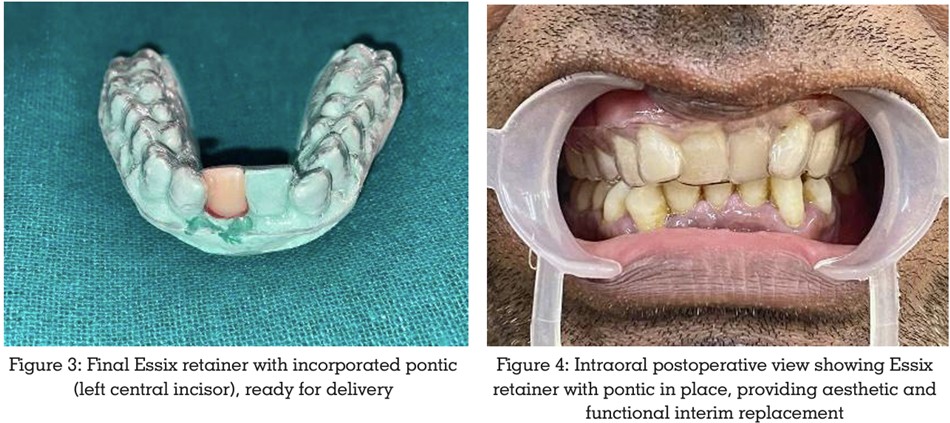
comfort (Figure 3). The final Essix retainer with
the embedded acrylic pontic was trial-fitted
intraorally to confirm esthetics, fit, and retention
(Figure 4).
The patient was instructed to wear the appliance
during the day and remove it at night to prevent
tissue impingement and allow mucosal rest.
Hygiene instructions included daily cleaning
with a soft toothbrush and non-abrasive soap,
and avoidance of biting into hard or sticky
foods to prevent distortion or damage to the
appliance. The patient was also advised to store
the appliance in water when not in use to prevent
dehydration and deformation of the acrylic
components.
At the one-week and one-month follow-up
appointments, clinical evaluation revealed
healthy healing at the implant site with no signs
of inflammation or complications. The patient
expressed satisfaction with the aesthetics and comfort of the Essix retainer being used as a
temporary prosthesis.
The Essix retainer with a pontic was selected
in this case as an interim prosthesis due to its
conservative, aesthetic, and patient-compliant
characteristics. Fabricated from a 1.0 mm
thick clear thermoplastic sheet. The appliance
conforms precisely to the dental arch offering
an inconspicuous and visually pleasing solution
that requires no tooth preparation or metallic
components.2 This is particularly beneficial in
the anterior maxillary region where preserving
gingival architecture, interdental papillae,
and soft tissue contours is critical to achieving
optimal long-term aesthetic outcomes.3
One of the key advantages of the Essix appliance
is its minimal contact with the edentulous ridge,
thus eliminating pressure on the implant site.
This facilitates undisturbed osseointegration
while still maintaining the space and gingival
form required for the future prosthesis.4 The
appliance’s lightweight nature, comfort in
function, and translucency enhance patient
acceptance, particularly among younger or
esthetically driven individuals who may be
reluctant to wear bulkier removable prostheses.5
Alternative interim options were evaluated but
ultimately deemed less suitable in this scenario:
Removable acrylic flippers are lightweight and
cost-effective but often suffer from poor retention
and instability. Their bulk and potential to
impinge on soft tissues may compromise peri
implant healing and alter ridge contour.5
Removable partial dentures (RPDs) provide
enhanced retention but are typically bulkier, can
impair speech and comfort, and may exert stress
on adjacent teeth and the healing ridge via their
clasps and base extensions.6
Resin-bonded fixed partial dentures (e.g.,
Maryland bridges), while more aesthetic and
fixed, require preparation of the lingual surfaces
of abutment teeth for metal wing bonding.
These preparations risk enamel compromise
and are technique-sensitive, especially in moist
environments. Debonding is not uncommon,
particularly in cases with occlusal challenges or
parafunctional habits.7
In contrast, the Essix retainer with a pontic
provides a non-invasive, cost-effective, and
biocompatible solution that meets the aesthetic,
functional, and biological demands of the
interim phase in implant dentistry.2,3 Its ability
to preserve the soft tissue profile, avoid implant
site trauma, and ensure patient comfort makes
it a preferred choice in many anterior implant
cases. Proper case selection is crucial. The
Essix appliance is best suited for single missing
anterior teeth, particularly when adjacent teeth
are intact and patient compliance is expected.
It is not recommended in cases requiring
long-term temporization beyond the typical
osseointegration period or in patients with
parafunctional habits.4
Essix retainers with a pontic serve as an effective
interim prosthetic option in anterior implant
cases, offering esthetics, comfort, and soft tissue
preservation without compromising the healing
process. Their clear thermoplastic design avoids
pressure on the surgical site, maintains gingival
architecture, and ensures patient compliance.
Easy to fabricate and cost-efficient, they are
especially beneficial for single missing teeth
in esthetically sensitive areas. This technique
not only improves patient satisfaction and
confidence during the transitional phase but
also supports optimal conditions for the final
prosthesis.