Aim: To evaluate and compare the marginal fit
and thickness of cobalt-chromium (Co-Cr) metal
copings fabricated using computer-aided design/
computer-aided manufacturing (CAD/CAM) milling
and direct metal laser sintering (DMLS) techniques.
Settings and Design: This study is an invitro analysis
of the CADCAM and DMLS cobalt chromium metal
copings.
Methods and Material: A standardized typodont
molar tooth was prepared and scanned to obtain
a digital model using CAD software. A total of
thirty-two Co-Cr copings were fabricated for two
groups: Group I (n = 16) – CAD/CAM-milled copings,
and Group II (n = 16) – DMLS-fabricated copings.
Marginal fit was evaluated under a stereomicroscope
at four predetermined sites (mid-buccal, mid-palatal,
mid-mesial, mid-distal). Thickness was measured
using a thickness gauge at the same sites.
Statistical analysis used: Data were analysed using independent t-tests with a significance level of p
< 0.05.
Results: DMLS copings exhibited significantly
superior marginal fit compared to CAD/CAM copings
(p < 0.05). The mean marginal discrepancy for CAD/
CAM ranged from 88.9 to 90.1 ± 4.2 µm, whereas for
DMLS it ranged from 65.4 to 67.0 ± 5.6 µm. Thickness
values showed greater uniformity in DMLS copings,
with statistically significant differences between the
two groups across all sites (p < 0.0001).
Conclusion: Within the limitations of this in vitro
study, DMLS fabricated Co-Cr copings demonstrated
better marginal adaptation and more consistent
thickness compared to CAD/CAM-milled copings.
These findings suggest that DMLS may provide
enhanced marginal fit and thickness in prosthodontic
restorations.
Key words: direct metal laser sintering, CAD/CAM, cobalt chromium copings, marginal fit, thickness.
The accuracy of marginal fit and the uniformity
of coping thickness are fundamental
determinants of the long-term success of fixed
dental prostheses. Inaccurate adaptation
at the margins of restorations can lead to
microleakage, plaque accumulation, secondary
caries, and periodontal breakdown, thereby
compromising clinical outcomes and patient
satisfaction. Similarly, variations in coping
thickness influence the strength of the restoration,
aesthetic performance of veneering porcelain,
and overall biomechanical stability.1,2
Traditionally, the lost-wax casting technique
was the mainstay for fabricating metal copings.
Although widely used, this method is prone to
inaccuracies due to multiple manual steps and
technical sensitivity. With advancements in digital
dentistry, such as subtractive manufacturing
technique like CAD/CAM milling and additive
manufacturing technique like DMLS, have
emerged as alternatives that promise superior
precision, reproducibility, and efficiency but
the necessity to compare and analyse the best
among these methods lead to this study.3-5
The CAD/CAM system fabricates copings by
milling a pre-sintered or solid metal block based
on digital designs generated through intraoral
or laboratory scanners. This subtractive method
ensures standardized production with reduced
operator dependence. However, limitations
such as tool wear, difficulty in replicating
intricate geometries, and material wastage may
affect marginal adaptation and uniformity of
thickness.6,7
DMLS, an additive manufacturing technique,
builds copings layer by layer using a high
powered laser to sinter cobalt-chromium powder
according to CAD designs. The layer-wise
fabrication allows for accurate replication of
complex anatomical features, minimal material waste, and potentially enhanced marginal
precision. Studies have demonstrated that
additive techniques like DMLS can overcome the
shortcomings of subtractive milling, providing
restorations with improved fit and predictable
thickness.8-10
Cobalt-chromium alloys continue to be
the material of choice for metal copings in
fixed prosthodontics owing to their excellent
mechanical strength, corrosion resistance,
and biocompatibility. The introduction of
digital fabrication technologies has expanded
the potential of these alloys by reducing
errors and ensuring clinical acceptability of
restorations.11-14 Given the clinical relevance
of marginal adaptation and coping thickness,
it is imperative to compare the performance of
different fabrication methods. Although multiple
studies have evaluated CAD/CAM and DMLS
techniques individually, comparative data
regarding Co-Cr copings remain limited. This in
vitro study was therefore designed to assess and
compare the marginal fit and thickness of Co
Cr copings fabricated using CAD/CAM milling
and DMLS, with the null hypothesis that there
would be no significant difference between the
two methods of fabrication.
An experimental study was conducted to
compare the marginal fit and thickness of
cobalt-chromium (Co-Cr) copings fabricated
by CAD/CAM milling and direct metal laser
sintering (DMLS). This study was done in an
invitro setting over a period of six months from
the procurement of materials, fabrication of the
copings, statistical analyses and arriving at
the final result. The ethical clearance for this
study was obtained from the Institutional Ethical
Committee (No:21/ETHICS/2023).
A standardized typodont molar tooth was prepared with a chamfer finish line and a 6° taper
according to accepted prosthodontic guidelines
by Shillingburg. The tooth was scanned with
a laboratory scanner (Trios Scanner, 3Shape,
Denmark) to obtain a STL file. A coping was
designed using CAD software (Exocad, 3Shape,
Germany).15
The sample size was calculated by using OpenEpi
software by which the mean and standard
deviation for the sample size calculation were
taken from the study done by Gunsoy S et al.,
the sample size of 16 per group was achieved.8
A total of 32 Co-Cr copings were fabricated and
divided into two groups:
Group I (CAD/CAM): 16 copings milled from CoCr alloy blocks (CORiTEC CoCr) using a 5-axis
milling unit (CoriTec 350i, Imes-icore GmbH,
Germany). [Figure 1]
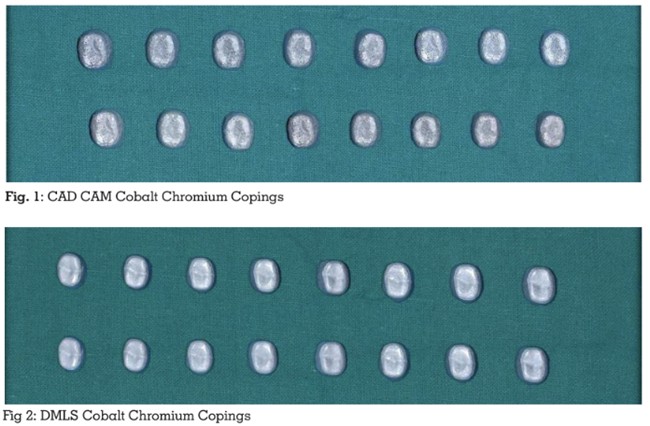
Group II (DMLS): 16 copings fabricated layer
by layer from Co-Cr metal powder (EOS Co-Cr)
using a DMLS machine (EOS M100, EOS GmbH,
Germany). [Figure 2]
Each coping was seated on the master die and
evaluated under a stereomicroscope (Leica
M205, Germany) at 30X magnification. Marginal
gaps were measured at four predetermined
sites—mid-buccal, mid-palatal, mid-mesial, and
mid-distal. The mean value for each coping was
calculated and expressed in micrometres (µm).3-6
Coping thickness was measured at the same four sites using a digital thickness gauge (Kreoplin,
Germany). Values were recorded in millimetre
(mm), and mean thickness for each coping was
calculated.8
Data were entered in Microsoft Excel and
analysed using IBM SPSS (Version 25.0, IBM
Corp., USA). Descriptive statistics (mean ± SD)
were calculated. Independent t-tests were used
for intergroup comparisons, with a significance
level set at p < 0.05.
A total of 32 Co-Cr copings were evaluated:
16 fabricated by CAD/CAM milling and 16 by
DMLS.
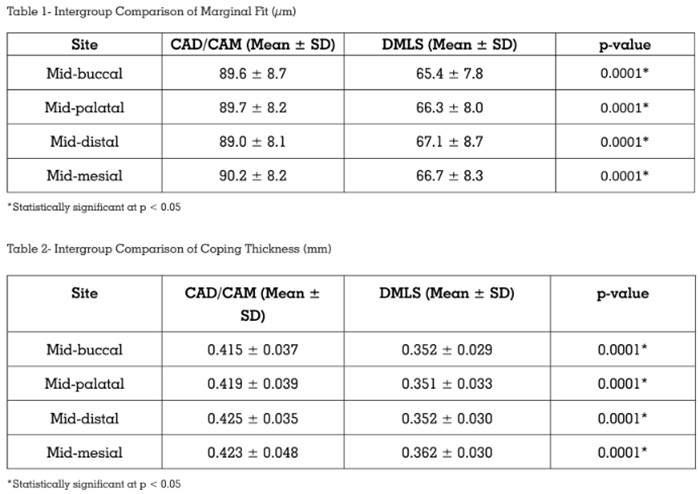
The mean marginal gap values of CAD/CAM
copings were significantly higher compared to
DMLS copings at all four measurement sites (p <
0.05). The mean marginal discrepancy for CAD/
CAM ranged from 88.9 to 90.1 ± 4.2 µm, whereas
for DMLS it ranged from 65.4 to 67.0 ± 5.6 µm.
All values fell within the clinically acceptable
range (<120 µm). [Table 1] [Figure 3]
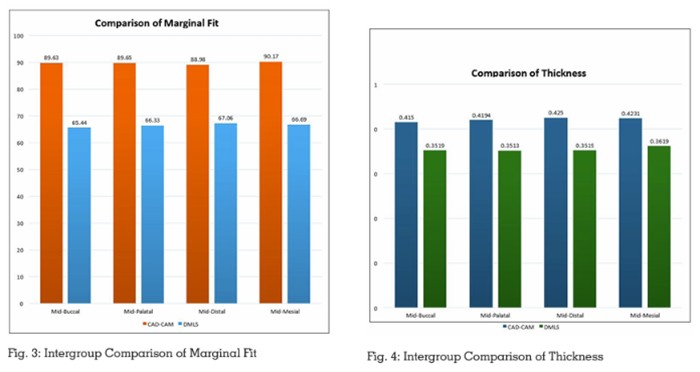
The mean thickness of DMLS copings was
significantly lower and more uniform than that
of CAD/CAM copings (p < 0.0001). CAD/CAM
copings exhibited a mean thickness between
0.415–0.425 mm, while DMLS copings showed
more consistent values of 0.351–0.362 mm across
all sites. [Table 2] [Figure 4]
Marginal fit: DMLS copings had significantly
better adaptation than CAD/CAM.
Thickness: DMLS copings demonstrated more
uniform and consistent coping thickness.
The present study evaluated and compared the
marginal fit and thickness of cobalt-chromium
metal copings fabricated by CAD/CAM milling
and DMLS methods. Within the limitations of this
in vitro design, the results showed that DMLS
copings exhibited significantly superior marginal
fit and more uniform thickness compared to
CAD/CAM copings.16-20
Marginal adaptation is a key determinant of the
longevity of fixed prostheses. Poor marginal fit
predisposes to microleakage, secondary caries,
and periodontal disease. The results of this study
demonstrated mean marginal gaps of 65–67 µm
for DMLS and 88–90 µm for CAD/CAM copings,
both within the clinically acceptable range of
≤120 µm.
These findings are consistent with previous
studies. Vojdani et al. and Lövgren et al.
reported that laser-sintered copings showed
smaller marginal discrepancies compared to
milled or conventionally cast copings. Similarly,
Park et al. and Gautam et al. observed that
DMLS provided improved marginal adaptation
compared to casting techniques. In contrast,
Doddy et al. reported superior accuracy for
CAD/CAM zirconia copings compared to DMLS
Co-Cr copings, highlighting that material type
and processing parameters may influence
outcomes.1-5
The improved adaptation of DMLS in the
present study can be attributed to its additive
manufacturing process, where copings are built
layer by layer, minimizing distortions associated
with milling burs or casting shrinkage.
Uniform coping thickness is critical for ensuring
adequate strength and providing sufficient space
for veneering porcelain. In this study, DMLS
copings demonstrated consistent thickness (0.35–0.36 mm), whereas CAD/CAM copings
showed slightly higher and more variable values
(0.41–0.42 mm).
Shah et al. highlighted that coping thickness
directly influences marginal adaptation,
especially after porcelain firing cycles. Our
findings support this by demonstrating that the
precision of layer-by-layer fabrication in DMLS
ensures dimensional stability and reproducibility.
Kim et al. and Zeng et al. similarly reported that
selective laser sintering and melting techniques
produce copings with uniform thickness and
acceptable marginal accuracy.6-8
The superior performance of DMLS copings in
both fit and thickness has practical significance:
Better marginal
adaptation reduces
microleakage and risk of secondary caries.
Uniform thickness ensures structural durability
and optimal esthetic veneering space.
Additive manufacturing enables fabrication
of complex geometries, offering customized
restorations.
Thus, DMLS may be a preferred option for
posterior crowns and multi-unit fixed prostheses
where precision and durability are paramount.
The strengths of this study are the use of
standardized preparation, fabrication, and
evaluation methods, which minimized variability.
Both stereomicroscope and thickness gauge
measurements allowed objective evaluation.
Limitations include the in vitro design, which
does not replicate intraoral factors such as
saliva, occlusal loading, and thermal cycling.
Additionally, only a single alloy (Co-Cr) and
coping design were evaluated. Future research
should incorporate ceramic veneering, long
term mechanical testing, and clinical follow-up
to validate these findings.
Overall, the findings of this study align with the
majority of published literature indicating that
DMLS provides enhanced marginal adaptation
compared to subtractive and conventional
techniques. However, the clinical acceptability
of CAD/CAM copings remains high, and the
choice of technique may depend on laboratory
infrastructure,
cost,
requirements.21-3
Within the limitations of this in vitro study, cobalt
chromium copings fabricated using direct metal
laser sintering (DMLS) demonstrated superior
marginal adaptation and more uniform coping
thickness compared to those fabricated using
CAD/CAM milling. Both techniques produced
values within clinically acceptable ranges;
however, the enhanced precision and consistency
of DMLS suggest it may offer better clinical
outcomes for fixed prosthodontic restorations.