Dr. Kavitha Janardanan Associate Professor, Department of Prosthodontics, Government Dental College, Thiruvananthapuram.
Temporomandibular joint is otherwise known as
Quadratoarticular joint
Incudomalleolar joint
Squamosodentary joint
Primary joint
The first component of temporomandibular joint to become
recognizable embryonically
Condyle
Articular disk
Temporomandibular ligament
Articular capsule
Following are the derivatives of Meckels cartilage, except
Incus
Temporomandibular ligament
Anterior ligament of malleus
Sphenomandibular ligament
The primary cause of Bennett movement is
Inclination of articular eminence
Tightness and orientation of temporomandibular
ligament
Tooth contacts and cuspal inclines
Contraction of external pterygoid muscle
The unit of speech by which one utterance can be
distinguished from another
Phoneme
Consonants
Surd
Sonant
“The only correct position of a tooth is the one in which
it was placed by Nature” was stated by
Misch
Branemark
De Van
Boucher
The radiation dose around existing implants in mandible
is increased by 11 to 15% in the adjacent 1mm zone due
to
Back scatter
Transmission
Absorption
Coherent scattering
The combination of Monson and anti-Monson curves in
posterior occlusion is referred to as
Transverse compensating curve
Reverse curve of Wilson
Pleasure curve
Curve of Von Spee
Choose the wrong statement
Teeth with 30° cups set on a 0° plane of occlusion will
balance in protrusive excursion if molar and incisal
guidance are both 30°.
Teeth with 30° cusps can be set in a compensating
curve if the condylar guidance is
20° and the incisal guidance is 0°.
If the incisal guidance is approximately 0°, it is
impossible to use a tooth with a cuspal inclination higher
than that of condylar guidance to achieve balance.
If the incisal guidance is established considerably
higher than the condylar guidance, it is virtually
impossible to set teeth upright to achieve balance.
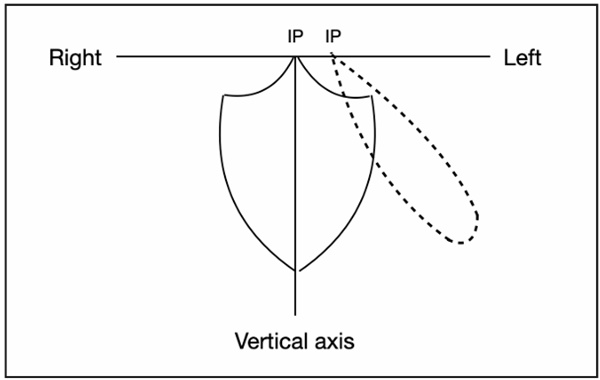
The mandibular movement depicted by the dotted line
in a lateral mandibulectomy patient is