Partial glossectomy can significantly impact speech, swallowing, and overall oral function. Conventional complete dentures often fail to restore these functions due to insufficient tongue–palate contact. Palatal augmentation prosthesis (PAP) is a rehabilitative approach that modifies the palatal contour of the maxillary denture to reduce the distance between the tongue and palate, thereby facilitating improved articulation and bolus control. By enhancing functional contact during speech and the oral phase of swallowing, it plays a crucial role in restoring phonetics and deglutition. Various techniques have been described for its fabrication; however, functional recording methods that capture dynamic tongue movements are considered more effective in achieving optimal outcomes. This case report highlights the importance of individualized prosthetic design in improving oral function and quality of life in patients with compromised tongue mobility.
Key words: palatal augmentation prosthesis, partial glossectomy, complete denture
Complete dentures aim to restore function, form,
esthetics, phonetics and maintenance of health
in edentulous patients1. However, in certain
conditions such as reduced tongue mobility,
neuromuscular disorders, partial glossectomy,
or age-related tongue atrophy, patients may
experience difficulty in speech articulation and
swallowing even after conventional denture
rehabilitation.
Palatal augmentation prosthesis isa removable
maxillofacial prosthesis that alters the hard and/
or soft palate’s topographical form adjacent to
the tongue; it allows reshaping of the hard palate
to improve tongue/palate contact during speech
and swallowing to compensate for impaired
tongue mobility as a result of surgery, trauma, or
neurological or motor deficits2. Modification are
designed to reshape the palatal contour of the
maxillary denture, thereby reducing the distance
between the tongue and palate.
After surgery, tongue movement may be reduced
due to tissue loss or nerve damage, causing difficulty in speech and food control. In some
cases, the tongue may deviate or have limited
movement.3 Swallowing and phonetics can be
improved by augmenting the palatal surface of
the denture.
Palatal augmentation prostheses can be
fabricated using various techniques. Dawis
19874 extended the palatal portion inferiorly
using modeling wax, which was subsequently
replaced with autopolymerizing acrylic resin
and further refined over several weeks until the
desired contour was achieved.
This case report describes fabrication of
a maxillary complete denture with palatal augmentation in a partial glossectomypatient to
improve phonetics and oral functions.
Patient History and Examination
A 62-year-old male patient reported to the
Department of Prosthodontics, Rajas dental
college and hospital with a chief complaint of
missing teeth in upper and lower tooth region
for past 3 years. Patient revealed history of
carcinoma tongue and partial resection was done
4 years back. Patient was under radiotherapy
and completed 3 years back. Post radiation
changes led to progressive loss of dention that
resulted in completely edentulous state.
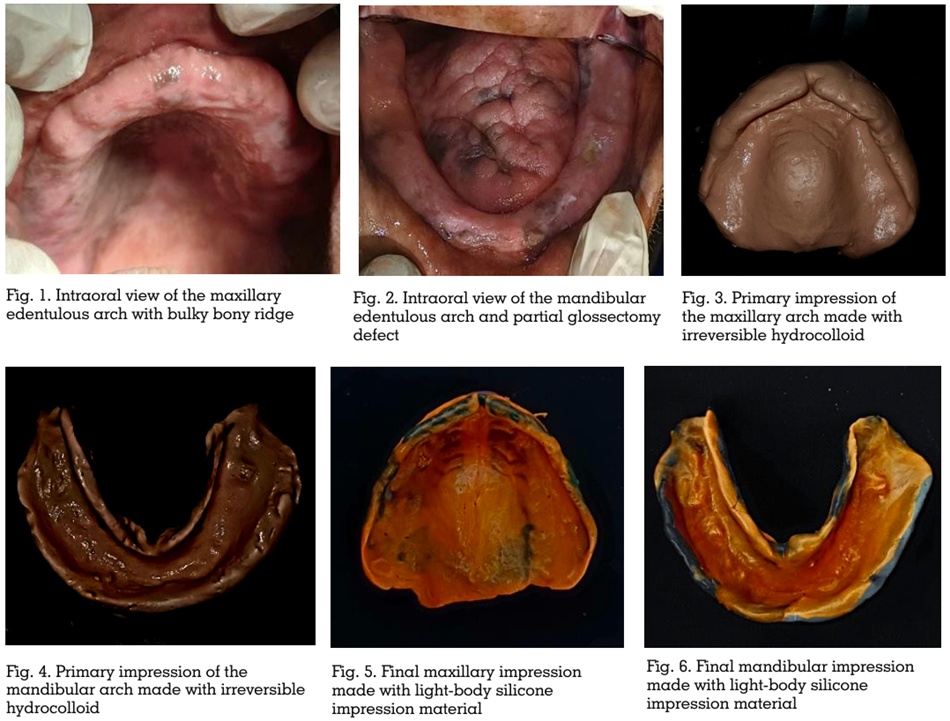
Intraoral examination revealed completely
edentulous maxillary and mandibular arches
with bulky and bony ridges (Fig.1,2). Soft tissue
examination revealed partial glossectomyalong
the right side and patient exhibited reduced
tongue mobility and difficulty in pronouncing
sounds such as /t/, /d/, and /th/.
Clinical Procedure
Primary impressions of both arches were made
using irreversible hydrocolloid impression
material (Fig. 3,4) and diagnostic casts were
obtained. Custom trays were fabricated on the
diagnostic casts. Border molding was performed
using low-fusing impression compound to
record functional vestibular extensions. Final impressions were made using light body sillicone
impression material (Fig.5,6) to obtain accurate
master casts. Occlusion rims were fabricated and
maxillomandibular jaw relationwas recorded.
Vertical dimension and centric relation were
established. Teeth were arranged following
conventional complete denture principles and a
try-in was conducted (Fig.7) to evaluate esthetics,
phonetics, and occlusion.
During the try-in procedure, silicone putty
material was added to the palatal surface of the
maxillary denture in the region corresponding
to the tongue contact area (Fig.8). The patient
was instructed to perform speech movements
by pronouncing /t/, /d/, and /th/ and swallowing actions. The process was repeated till the patient
pronounced them correctly.
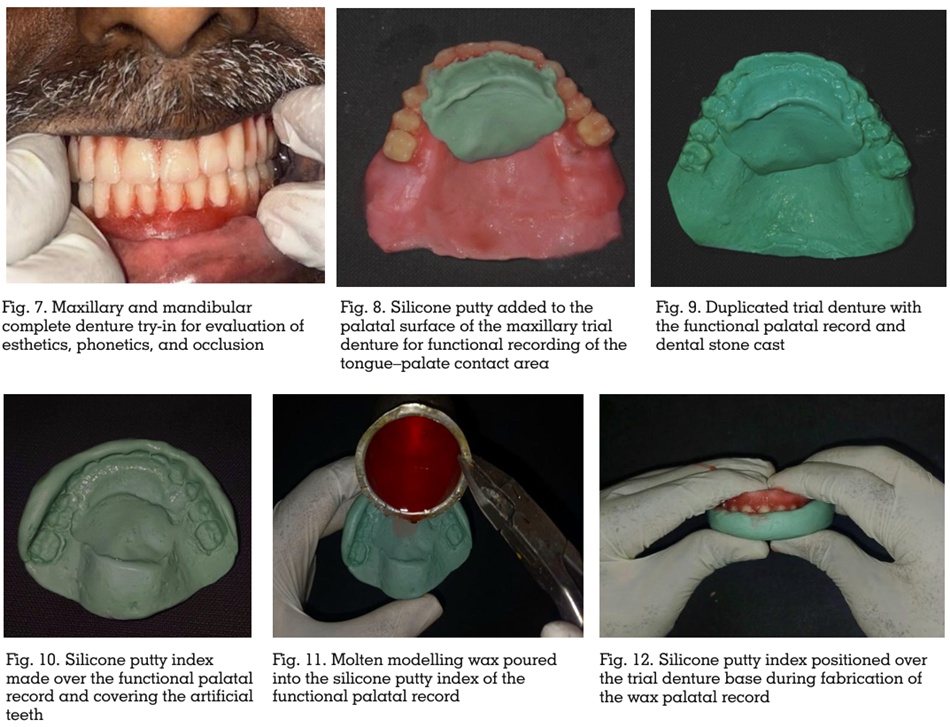
After functional recording of the palatal contour
the trial denture with palatal record was
duplicated by using irreversible hydrocolloid
impression material and cast was poured with
dental stone (Fig. 9). Then silicone putty index
was made over the palatal record covering
the artificial teeth (Fig. 10). Modeling wax was
placed in wax bath and molten wax was poured
into the putty index of the palatal record (Fig. 11).
After initial cooling the index was placed over
the trial denture base (Fig. 12) and after setting
of the wax the index is removed.
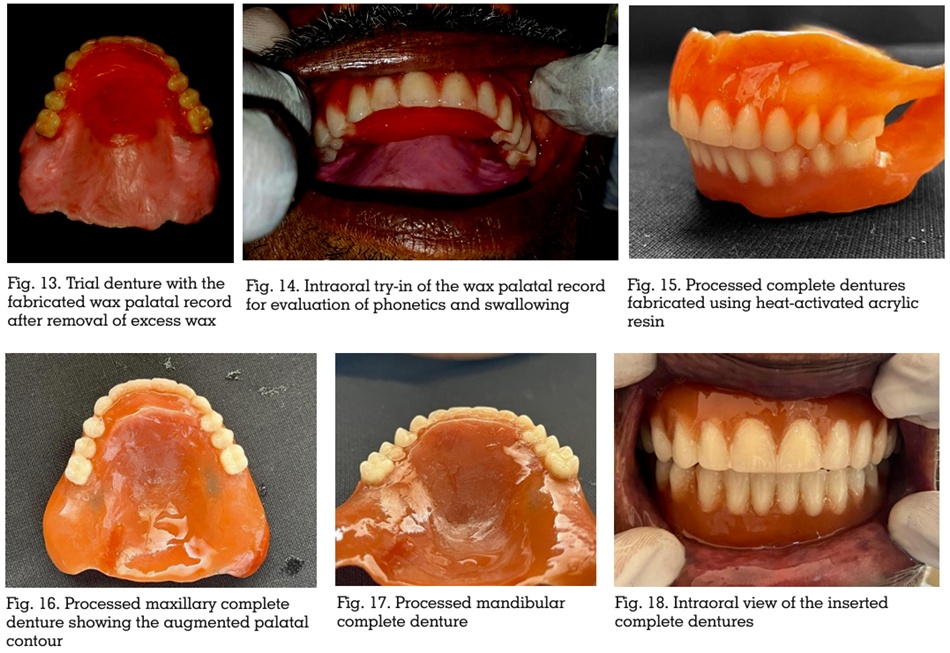
The excess wax over the palate and teeth were
removed and trial denture with wax palatal
record (Fig.13,14) was tried in the patient mouth for phonetics and swallowing and
corrected if necessary. After confirmation of the
functional palatal contour, the dentures were
processed using heat-activated acrylic resin
(Fig.15-17). The palatal contour was preserved
during processing. The dentures were inserted
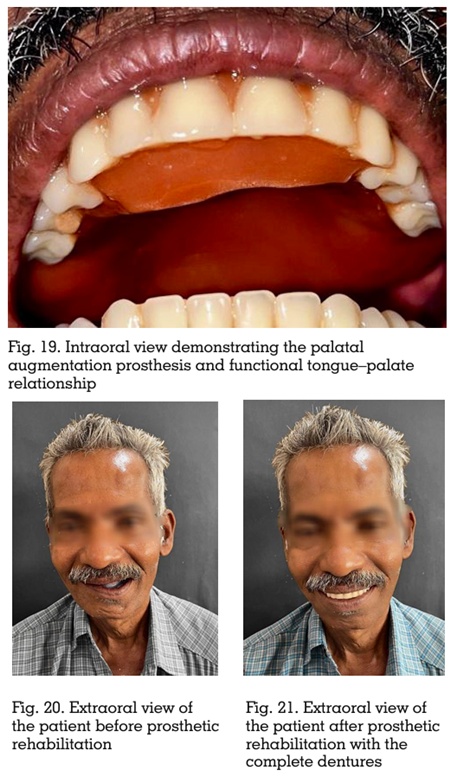
(Fig.18,19) and evaluated for retention, stability,
occlusion, and phonetic performance. Necessary
adjustments were made, and the patient was
given instructions for denture maintenance. The
patient was recalled after 2 weeks for follow-up
evaluation.
Quality of life assessment
During the second week follow up, quality of
life assessment was done by using University
of Washington Quality of Life Questionnaire
(UW-QoL v4). The translated and validated questionnaire5 was given in patients own
language (Tamil) and evaluated.
Patient’s ability to chew and swallow has
improvedconsiderably. Previously, he had
difficulty with phonetics and now, he has better
pronounciation and speech clear enough to be
understood. His salivary consistency is within
normal limits.
Partial glossectomy significantly impairs
mastication, swallowing, and speech due to reduced tongue mass and mobility. The residual
tongue’s inability to achieve sufficient palatal
contact affects bolus control and articulation6,
which impacts overall oral function and quality of
life. A proper swallowing cycle needs adequate
pressure against the palate and contact between
the tongue and the palate during the oral phase.
It is not possible in cases with resected tongue
due to its limited mobility. Logemann 19897 found
that intra oral reshaping of prosthesis resulted to
improve swallow efficiency in patients who had
undergone resection.
The articulation of certain parts of the tongue
and palate is also necessary for pronouncing
various sounds, which is necessary for good
intelligible speech. Pound 19508 stated that
anterior palatal region has an important role in
pronuncing of consonants. He also termed that
area ‘play ground’ of tongue as 90 % of tongue’s
rapid manipulation while talking was restricted
to this area and area lingual to lower anterior
teeth.
Palatal augmentation prosthesis (PAP) is a
rehabilitative approach that modifies the palatal
contour to improve tongue–palate contact. This
facilitates efficient bolus propulsion during
swallowing and enhances speech intelligibility
by restoring articulation points9. The effectiveness
of PAP depends on recording a palatal contour
compatible with the functional movements of the
residual tongue.
Abdulhadi 201210 in a case report augmented
palate by using tissue conditioning material
which was added layer by layer performing
functional tongue articulatory movements and
after 3 days of denture usage the functional
record was replaced with heat cured acrylic
resin.
Lampe 201611 in a case report used irreversible
hydrocolloid impression material to record
functional movement of the resected tongue.
Application of this material is easy and the setting time is long enough to give adequate time for
functional movements of the tongue. However,
the process of converting the hydrocolloid record
into a wax record was not clearly described.
Considering the short comings of these methods
a modified approach was framed in this case by
using condensation silicone impression material
to perform tongue movements recording which
was then duplicated with irreversible hydrocolloid
impression material and poured with type III
gypsum onto which another index was made
using condensation silicone and poured with
molten modelling wax. Palatal augmentation
prosthesis fabricated by this method showed
improved swallowing and speech articulation
that results in better prosthetic function and also
an impact on quality of life. The use of a hollow
palatal augmentation prosthesis may improve
patient comfort by reducing prosthesis weight
without compromising functional efficiency. Bin
Li 202512 in a case report duplicated existing PAP
using scanning and 3D printing and delivered.
The oral hypofunction test yielded satisfactory
results.
Long-term follow-up is crucial in patients treated
for squamous cell carcinoma due to the potential
for recurrence and ongoing tissue alterations.
Additionally, case reports are limited by their
reliance on subjective outcome assessments and
the absence of objective, quantitative functional
measurements. Overall, palatal augmentation
prosthesis constructed using this functional
technique can effectively enhance oral functions
in patients with resected tongue. The selection
of technique may be guided by clinician
preference and individual patient factors. Patient
participation during functional shaping and an
adequate adaptation period also play crucial
roles in achieving optimal treatment outcomes.
A palatal augmentation prosthesis is a simple
but functionally transformative solution for oral rehabilitation after partial glossectomy. PAP
may significantly improve speech intelligibility,
swallowing efficiency and general oral function
by restoring effective tongue-palate contact
through an individualized palatal contour.
Furthermore, functional recording techniques
that capture dynamic tongue movements enable
accurate prosthetic adaptation to the patient’s
specific functional limitations. Therefore PAP
should be considered not only as a denture
modification but also as a functional prosthesis
specific for the patient to restore confidence,
communication and quality of life in those with
impaired tongue mobility.